
「2018年7月」の記事一覧
大和田先生(市立室蘭総合病院)、飯田先生の論文がPLOS oneにacceptされました
Clinicopathological comparison between acute gastrointestinal-graft-versus-host disease and infectious colitis in patients after hematopoietic stem cell transplantation.
Sae Ohwada*, Tomoya Iida*, Daisuke Hirayama, Gota Sudo, Toshiyuki Kubo, Masanori Nojima, Kentaro Yamashita, Hiroo Yamano, Hiroshi Nakase. (*equally contributed)
AOCC 2018 に参加しました
当科大学院生の飯田先生、我妻先生、市立室蘭総合病院所属の大和田先生がAOCC 2018(THE 6TH ANNUAL MEETING OF ASIAN ORGANIZATION FOR CROHN’S & COLITIS, June 21-24, 2018, Shanghai, China)に参加されました。大和田先生、すごい人数に囲まれていますね(笑) 皆、卒後10年以内ですが、国際学会においても立派に発表されております。さて、参加された感想をお伺いしました。
【我妻 先生】
この度,AOCC 2018に参加させていただきました。
演題は「Crohn病患者における腸内細菌とvitamin K欠乏の代替指標であるundercarboxylated osteocalcinの関連」でした.
私はポスターセッションでpresentationはありませんでしたが,私にとっては初めての国際学会で貴重な体験でした.自分の発表だけではなく,他の演題の理解,discussionのためには英語力が必要だということを改めて感じさせられました.今回の学会で高まったモチベーションで,また次回の国際学会を目指していきます.最後に,このような機会を与えてくださり,ご指導いただきました仲瀬教授,飯田先生ありがとうございました.
【大和田 先生】
今回,初の国際学会に参加させていただきました.
演題は「Clinicopathological comparison between acute gastrointestinal graft-versus-host disease and infectious colitis in patients after hematopoietic stem cell transplantation」で,poster oral発表という大変貴重な機会を与えていただきました.
発表当日は,他国の大勢のdoctorが一堂に会しており,日本の学会とはまた違う雰囲気を味わうことができました.肝心の発表に関しては,自分の英語力の低さを思い知らされ課題が残る結果となりましたが,今後はこの経験をバネに,日々の臨床はもちろん,学会活動などでもより一層の努力をしていこうという決意を新たにできました.
今回の発表に際して,仲瀬教授,飯田先生をはじめとしたたくさんの先生方にお力添えをいただき,感謝の言葉が尽きません.この度は貴重な機会をいただき,本当にありがとうございました.
石上先生がDigestive Disease Week 2018 (June 2-5, 2018@Washington D.C.) に参加しました
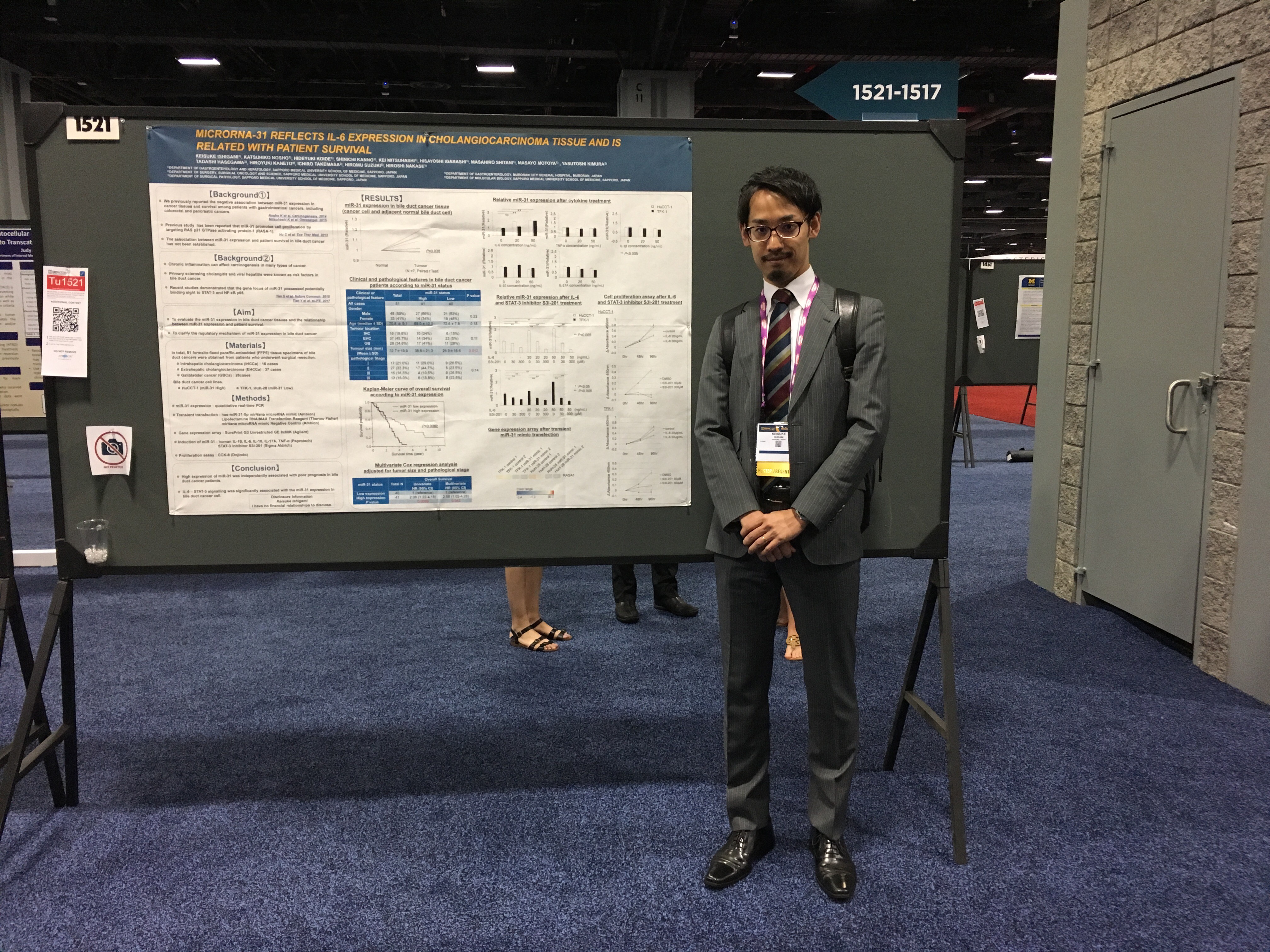
6/2-5の日程で米国Washington D.C.で開催されていた、Digestive Disease Week 2018に参加し、poster presentationを行いました。臨床検体でご協力頂いた市立室蘭総合病院・金戸宏行先生、本学病理診断部の長谷川匡教授、消化器外科・竹政伊知朗教授、木村康利先生に御礼申し上げます。また、何よりご指導いただいた仲瀬裕志教授、能正勝彦先生のおかげでこのような機会が得られたと思っています。
お世話になったすべての先生に、この場をお借りして深く御礼申し上げます。
昨年は緊張して周りが見えませんでしたが、今年は自分のポスターの前を素通りする人ばかりで、非常に悔しい思いをしました。次はもっともっと面白いデータを持って、先輩や後輩と一緒に参加したいなぁと思います。
弾丸ツアーだったので観光はほとんどできず、行きかえりのタクシーの運転手との会話(片道約40分)が一番現地の人とたくさんしゃべった思い出です。
英語もやはり日々の鍛錬が重要だな、と痛感しています…。
MicroRNA-31 reflects IL-6 expression in cholangiocarcinoma tissue and is related to patient survival
Background & Aims: We previously reported the impact of MicroRNA-31 (miR-31) on patient survival in gastrointestinal cancers (e.g., colorectal cancer and pancreatic cancer). With regard to cholangiocarcinoma, miR-31 has been reported to be upregulated in tumor tissues, and it not only promotes cellular proliferation but also inhibits apoptosis. Nevertheless, no study has reported the association between miR-31 expression and patient survival. We therefore evaluated miR-31 expression in cholangiocarcinoma tissues and its relationship with prognosis. Furthermore, we examined the impact of several cytokines on miR-31 expression in cholangiocarcinoma cell lines to investigate whether this could reflect cytokine expression in tumor tissues.
Methods: To examine the expression of miR-31 in cancer tissues, we performed quantitative reverse transcription-polymerase chain reaction in 81 cholangiocarcinoma patients (16 with intrahepatic cholangiocarcinoma, 37 with extrahepatic cholangiocarcinoma, and 28 with gallbladder cancer). To investigate the influence of cytokines on miR-31 expression, cholangiocarcinoma cell lines were stimulated with cytokines. For functional analysis, we conducted proliferation assays and Western blotting.
Results: The expression level of miR-31 was significantly higher in cholangiocarcinoma cells than in normal bile duct epithelium cells (P = 0.038). A significant association was not detected between miR-31 expression and clinical or pathological characteristics, such as gender, age, tumor location, N factor, M factor, and disease stage, except for tumor size (P = 0.012). In the Kaplan–Meier analysis, high miR-31 expression was significantly associated with shorter survival (log-rank test, P = 0.0082). In the multivariate Cox regression analysis, high miR-31 expression was significantly associated with prognosis (P = 0.043), independent of clinical and pathological features. Functional analysis of cholangiocarcinoma cell lines revealed that IL-6 significantly promoted miR-31 expression and cell proliferation in a dose-dependent manner. The promoter of miR-31 contains a potential binding site for phosphorylated STAT-3, and inhibition of STAT-3 signaling significantly suppressed miR-31 expression and cell proliferation.
Conclusion: High miR-31 expression was observed in cholangiocarcinoma cells, and this high expression was significantly associated with worse prognosis in the patients. Our data also revealed that the IL-6–STAT-3 signaling pathway regulates the proliferation of cholangiocarcinoma cells and the expression of miR-31. These data suggest that miR-31 may be a promising biomarker that reflects IL-6 expression in cholangiocarcinoma tissues and predicts worse prognosis.
飯田先生(大学院所属)が、Digestive Disease Week 2018 (June 2-5, 2018@Washington D.C.) に参加しました
Digestive Disease Week (DDW) は米国の消化器関連学会が一堂に会する非常に規模の大きな学会です。
我々は「Therapeutic effects and adverse events of tacrolimus on patients with Crohn’s disease: A systematic review and meta-analysis」というタイトルで、Poster発表を行いました。仲瀬教授と東京大学の野島准教授に御指導をいただいて、このような場で発表をすることが出来ました。あとは論文が通れば嬉しいのですが。。。
来年はSan Diegoにて開催されるとのことですが、次はもう少しまともな英語を話せるように、そして後輩と一緒に来ることが出来るように、日々努力していきたいと思います。
本発表に際し、御世話になった全ての方に深謝致します。
Background and Aim: There are evidences showing that tacrolimus (TAC) could be useful for induction of remission for patients with ulcerative colitis. However, evidence regarding the efficacy and adverse events of TAC for patients with active Crohn’s disease (CD) is few. The aim of this study is to conduct a systematic review with meta-analysis on therapeutic effects and adverse events of TAC for patients with CD.
Methods: We investigated the studies which were reported therapeutic effects and adverse events of TAC for patients with CD from 1950 until June 2017 in PubMed, Embase, Web of Science and the Cochrane Library. The following MeSH were used: “Inflammatory bowel disease” AND “Crohn’s disease OR CD” AND “tacrolimus OR FK OR FK506” AND “calcineurin inhibitor”. Study subjects were categorized and analyzed by 3 groups; systemic administration of TAC for patients with luminal CD (Study 1), systemic administration of TAC for patients with perianal CD (Study 2), and topical administration of TAC for patients with localized CD (Study 3). Clinical response as well as clinical remission were studied. Additionally, factors related to remission and incidence of adverse events were studied. These were conducted by a specialist of medical statistics.
Results: 15 out of 109 publications were considered to be eligible for inclusion in this analysis. Finally, 9, 6, and 3 out of 109 publications were included in the analysis in Study 1, 2, and 3, respectively. The clinical response rate of Study 1, 2, and 3 was 83.9%, 59.2%, and 80.6%, respectively. The clinical remission rate of those was 37.5%, 28.6%, and 19.4%, respectively. In study 1, it showed an inverse correlation between clinical remission by TAC therapy and previous anti-TNFα treatments (R= -0.883). Remission rate in cases with previous anti-TNFα treatments was speculated as 20.5%, and that in cases without previous anti-TNFα treatments was speculated as 75.8%. The incidence of adverse events of three studies was 52.9%, 78.0%, and 40.0%, respectively. Serious adverse events did not occur in any studies.
Conclusions: This systematic review and meta-analysis showed the efficacy and safety of TAC therapy for patients with CD. TAC therapy is a valid therapeutic alternative for induction of clinical improvement for patients with active CD, and the incidence of adverse event was tolerable. In addition, we found that the efficacy of TAC therapy for patients in anti-TNFα naïve was higher than those who failed anti-TNFα treatments. Therefore, TAC therapy is considered as one of the options for patients with active CD. However, well-designed randomized control trial is few, and the long-term efficacy of TAC therapy for patients with CD remains unclear. Further studies are required to determine the efficacy and safety of TAC therapy for patients with active CD.
2018.6.18(月) 教室説明会 開催決定
学生、研修医、場合によっては他病院勤務中の現役Drでも
みなさまへきちんと対応いたします。
日時;2018.6.18(月) 17:30~
場所;臨床棟4階 消化器内科教室
説明会の後、懇親会も予定しております。
実際に勤務しているDrの生情報を聞くチャンスです。
是非お越しください!
2018.6.28 田尻先生講演会 開催
日本消化器内視鏡学会の理事長、田尻久雄先生が
2018.6.28(木) 18:30-19:30 に講演されます。
場所は記念ホールという、大学から西へ1本道路を渡ったところの建物です。
実は北海道出身だったのですね。是非御来場ください!
第115回日本内科学会総会・講演会の優秀演題賞受賞
2018年4月13-15日に第115回日本内科学会総会・講演会において、
「ことはじめ」という学生・研修医が発表を行うセッションがありました。
札医大6年生、佐藤君・今田さん・森川君の学生3名に加えて、
4月より当科へ入局した齋藤先生が発表を行いました。
みなさん堂々とした素晴らしい発表でした。ご苦労様でした!
そして、その中で森川君が優秀演題賞を受賞し、先日賞状が届きました!
当科としては一昨年の大和田先生、昨年の高田さんに続く3年連続での快挙です!
森川君、指導した本谷先生、本当におめでとうございました!
若いうちから全国学会で発表をすることは、
準備の段階でたくさんのことを学びますし、
ちょっとしたプレゼンでは動揺しない度胸が身につきます。
この経験をしたみなさまが数段レベルアップしたことは間違いありません。
当科はこれからも若手の成長を応援していきます!
仲瀬教授の全国Webセミナーで勉強しました
2018年5月30日19-20時、仲瀬教授がWebセミナーで講演されました。
「Optimizing use of Ustekinumab in treatment of Crohn’s disease
– lessons from the mechanism of action and clinical practice -」
クローン病に対する新規分子標的薬「ウステキヌマブ」を中心に、
その作用機序や注目されるに至った経緯など、
難しい内容をわかりやすく説明されておりました。
作用機序を理解した上で薬剤を臨床応用すること、
非常に重要なポイントであると考えます。
医局員も別会場で拝聴し勉強させていただきました!
第95回 消化器内視鏡学会総会に参加しました
第95回消化器内視鏡学会総会(会期;2018年5月10日~12日)で、
柾木先生が演題発表されました。
SpyGlassDSという新しいデバイスについて、
その有用性や適応が活発に議論されたそうです。
今後もどんどん新しい知見を発信いたします!
演題名:胆道病変の診断能におけるSpyGlassDSの有用性
近年、胆道病変の診断・治療目的にデジタル型経口胆道鏡SpyGlassDSが使用され、その有用性が報告されておりますが、今回は胆道病変の精査目的に同デバイスを使用した症例に対してその診断能の検討を行いました。まず、当院で胆道精査目的にSpyGlassDSを施行した34症例における、観察成功率は97.5%(119/122)、鏡視下生検の適正検体採取率は88.5%(69/78)といずれも高い成績でした。次に、切除標本による水平進展度を十分に評価可能であった肝外・肝内胆管癌18症例において、肉眼所見と切除標本の比較では、正診率86.8%(79/91)で、うち炎症性変化を癌と判断したことによる偽陰性が多くみられたのに対して、生検結果と切除標本の比較では正診率90.0%(45/50)と上昇がみられ、偽陽性率も11%から6%へと低下がみられました。目的部位への到達率は高く、特に二次分枝までの詳細な評価が可能であることは、手術適応や術式を選択する上で有用であると考えられました。進展度診断も良好であった一方で、胆道鏡のみでは正診困難な進展様式も存在し、他モダリティも組み合わせて総合的に診断することが肝要であると考えられました。
新しいホームページが出来ました!
5/1から札幌医科大学 消化器内科学講座のホームページが完成しました!
これからブログ更新していきたいと思いますのでよろしくお願い致します。
 トップページ